Stadium Microclimates Shape Goal Scoring Patterns in Premier League Fixtures
Written by Amir Friedrich · Aug 13, 2026

Stadium Microclimates Shape Goal Scoring Patterns in Premier League Fixtures
Stadium microclimates create localized weather conditions inside Premier League venues that differ from surrounding areas, and these variations influence ball behavior along with player movement during matches. Observers note that enclosed structures trap heat or channel wind in ways that alter passing accuracy and shot trajectories, which in turn affects the number of goals scored. Research from sports science programs at universities across North America and Europe has documented how temperature gradients and humidity pockets inside arenas change the aerodynamics of a football, leading to measurable shifts in match statistics.
Data collected over multiple seasons shows that venues with partial roofing experience distinct wind patterns compared to fully open grounds, and these patterns often reduce the effectiveness of long-range passes. When gusts swirl inside the bowl, crosses and set pieces land differently than expected, which forces teams to adjust their attacking approaches mid-game. Analysts tracking Premier League results have found correlations between these microclimate effects and lower goal tallies in certain fixtures, particularly during transitional months like August when early season schedules coincide with variable weather fronts.
Local Weather Dynamics Inside Premier League Grounds
Each Premier League stadium develops its own microclimate because surrounding buildings, roof designs, and pitch orientation interact with prevailing winds and sunlight angles. For instance, grounds situated near rivers or in urban valleys trap moisture that raises humidity levels near the playing surface, while elevated sites allow stronger air currents to sweep across the pitch. These conditions modify how the ball travels through the air, and goalkeepers along with defenders respond by altering positioning to account for unpredictable dips or swerves.
Studies conducted by atmospheric researchers indicate that temperature differences of just a few degrees between the pitch and stands create thermal updrafts capable of lifting a ball several centimeters higher than normal flight paths. Such changes become noticeable during evening fixtures when cooling air masses settle into the stadium bowl, and the resulting stability or instability directly impacts high balls and clearances. Teams that rely on aerial duels therefore encounter different success rates depending on the specific venue and its embedded weather characteristics.
Connections to Over/Under Market Outcomes
Over/under accumulators depend on total goals, and microclimate influences introduce variables that shift expected scoring rates away from seasonal averages. When wind speeds inside a stadium exceed typical thresholds, long passes lose precision while short combinations gain relative advantage, which tends to compress the playing area and limit open chances. Figures from match data providers reveal that fixtures played under these conditions produce fewer goals on average than those in calmer environments, and this pattern holds across multiple clubs regardless of their tactical setup.
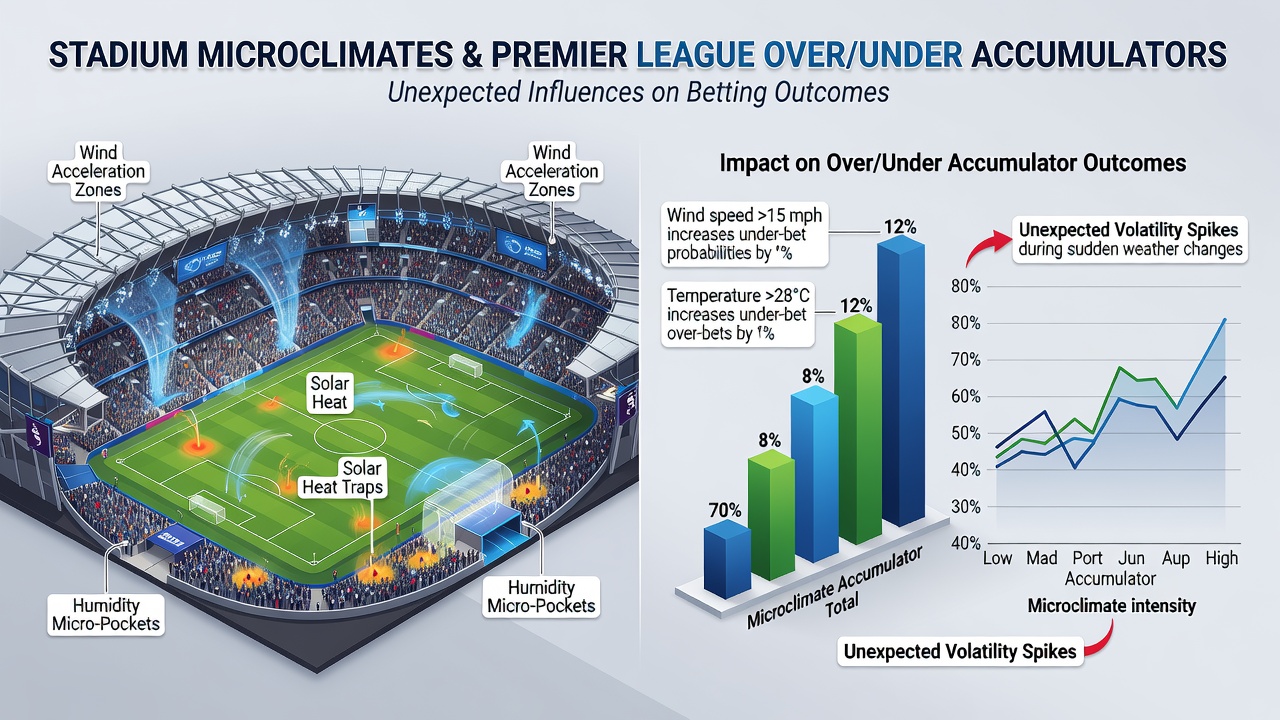
Humidity levels above 70 percent also affect player stamina because the air feels heavier, and this leads to slower transitions between defense and attack. Researchers tracking physiological responses during Premier League games have recorded increased fatigue markers in such conditions, which correlates with reduced shot volumes in the second half. Accumulator bettors who monitor venue-specific weather reports therefore gain insight into potential under trends when forecasts predict elevated moisture combined with moderate temperatures.
Examples From Recent Premier League Seasons
One case that stands out involves a northern venue where persistent crosswinds channeled by adjacent structures disrupted wing play throughout the 2025-2026 campaign, resulting in a higher proportion of matches finishing under the expected goal line. Similar observations emerged at coastal grounds during August 2026 when sea breezes interacted with stadium architecture to create swirling patterns near the corners, and teams recorded fewer successful deliveries from those areas. These instances demonstrate how site-specific factors compound over a season and produce repeatable effects on total goals.
Further analysis from European meteorological agencies has shown that indoor-like environments in newer stadiums maintain more consistent temperatures, yet the contrast with outdoor air at entry points still generates localized turbulence. Players crossing these boundaries mid-match experience subtle changes in ball grip and spin, which can influence the outcome of set-piece routines that often decide tight contests. Data sets compiled from league-wide tracking systems confirm that such micro-variations contribute to variance in goal distributions beyond what team form alone would predict.
Integrating Microclimate Data Into Betting Analysis
Those who study Premier League statistics increasingly cross-reference venue weather logs with historical scoring records to identify edges in over/under markets. Government weather services in Canada and Australia provide open datasets on wind and humidity that analysts adapt for football contexts, while industry reports from sports performance organizations highlight how these elements interact with pitch maintenance practices. The resulting models allow observers to adjust baseline goal expectations for specific fixtures rather than relying solely on team averages.
August 2026 fixtures provide a timely illustration because early-season schedules often feature unfamiliar lineups alongside shifting weather patterns, and microclimate effects become more pronounced when squads have not yet adapted to venue quirks. Match reports from that period noted several instances where unexpectedly low goal counts aligned with higher-than-average humidity readings inside particular stadiums, and these outcomes reinforced the value of incorporating environmental data into accumulator construction.
Conclusion
Stadium microclimates represent measurable environmental factors that influence Premier League goal totals through their effects on ball flight and player performance. Evidence from atmospheric studies and match tracking systems shows consistent patterns where wind, humidity, and temperature variations inside venues alter scoring rates compared to baseline expectations. Observers who integrate venue-specific weather information with statistical trends gain a more complete picture of the conditions that shape over/under outcomes across the league.